The ritual that changes everything (and why the classic "once upon a time" isn't enough anymore)
Your child is four years old, maybe six. You've read Little Red Riding Hood forty-three times. The Very Hungry Caterpillar too. In the evening, you settle on the edge of the bed, grab a book at random, and you can already see their eyes drifting toward the ceiling before page three. Not because they don't love stories anymore, not at all. Because the ones you're reading don't really speak to them.
At this age, what captures a little one's attention is seeing themselves in the story. Not symbolically, literally: their name, their best friend from school, their dog named Buddy, their worn-out stuffed rabbit called Hoppy. When that happens, you see the difference immediately. They sit up straight, they ask a real question, they beg for more. This isn't a whim, it's a cognitive mechanism documented by child psychologists: when children hear themselves named in a story, they're actively building their narrative identity.
This article brings together six methods that parents have shared with us since we started working on this subject. Six concrete ways to create a truly personalized bedtime story without becoming a full-time screenwriter. The sixth one is ours, and we'll lay it out openly · not to sell it to you, but so you can compare.
1. Making it up on the spot (free, demanding)
This is the rainy Sunday evening method. You ask your child for three words: an animal, a place, an object. A crocodile, the bathroom, a pink umbrella. You begin. The crocodile lives in the bathtub, the pink umbrella belongs to your daughter, the crocodile wants to get out because he's thirsty, but he doesn't know how to walk with the umbrella over his head.
What works: it's ultra-personalized, it's the parent-child bond at its finest, and children love it because they chose the ingredients.
The limitation: after four nights, you're exhausted. It's demanding, it requires narrative creativity, and after a long day at 7 p.m., you don't always have it in you. Save this for Fridays and Saturdays, not for weeknights.
2. The personalized photo book (great gift, occasional use)
You know the format: Wonderbly, My Magic Story, Put Me in the Story. You enter your child's name, age, sometimes physical traits online, you pay $30 to $50, and a hardcover book arrives in eight to ten days. Your child opens the package, sees their name printed on the cover, eyes go wide, asks you to read it three nights in a row.
What works: it's a keepsake object, wonderful for a birthday or special occasion, kept on the shelf and re-read with pleasure years later.
The limitation: it's a single story. After the fourth reading, your child knows it by heart, the book joins the pile. You can't request a new adventure with the same hero unless you buy another book. The cost per story quickly exceeds the value. And personalization often stops at the name and face: their dog Buddy and their friend Marcus don't make it into the cast.
3. Adapting an existing book by swapping names
This is the savvy grandparent technique. You read Curious George Goes to the Beach but say Liam Goes to the Beach. You replace all the names on the fly. Your child catches on immediately, laughs, corrects you when you forget to substitute.
What works: zero budget, it revives books that have gone stale, it's fun for a couple of weeks.
The limitation: children spot the copy-paste by age five. The story stays the same, only the names change. The magic of personalization wears off, the child doesn't recognize their world (their room, their school playground, their fears) in the story.
4. Story podcasts (Audible, Story Pirates, Circle Round)
You launch an age-appropriate episode on your smart speaker or tablet. A professional voice narrates, you can dim the lights and lie next to your child while a narrator takes over.
What works: the audio quality is excellent, the catalog is broad, it saves you on nights when you're truly drained.
The limitation: it's a fixed catalog. No personalization, your child is never in the story. It's passive listening more than a shared ritual. Save it for emergency nights or long car trips, not as a daily ritual if you're looking for that identification effect.
5. The handwritten fiction journal
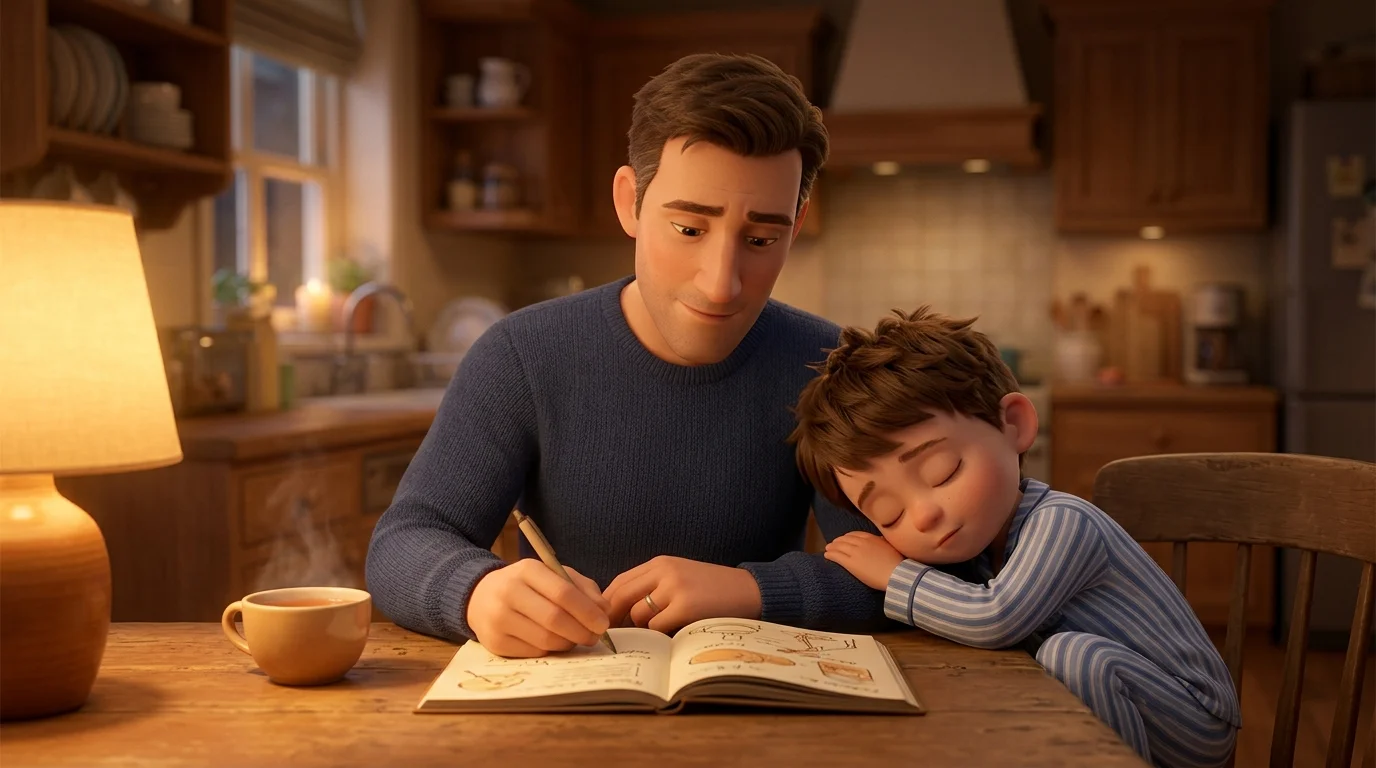
Rarer, but some parents do this: they keep a notebook where they write, chapter by chapter, the story of a hero named after their child. Monday night, one chapter. Tuesday, the next.
What works: it's the precious object, the family heirloom, the child who sees their mother or father writing just for them.
The limitation: it's a colossal time investment. For a parent who enjoys writing and has half an hour on Sunday, it's magnificent. For others, it's unrealistic. This method deserves to exist, we mention it, we don't recommend it for everyday use.
6. The app that generates your story every night (our method)
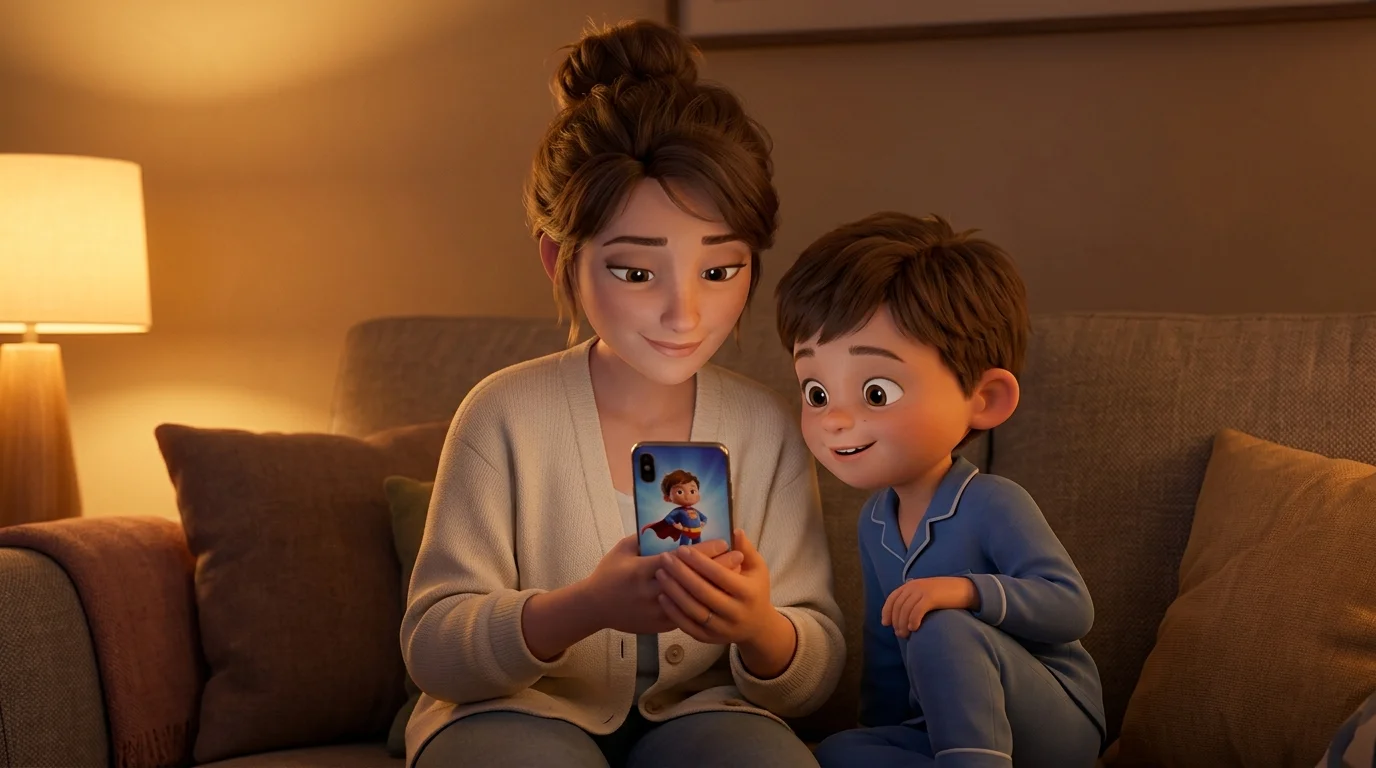
You open Nanou Studio on your phone. You set up your child: their name, age, photo (transformed into a stylized 3D rendering with cinematic animation quality). You add their dog, their classmate, their stuffed animal. You choose tonight's theme: adventure, mystery, superhero, fantasy, sci-fi, comedy, family, or something a little spooky. In three minutes, the app generates a custom-written story, illustrated scene by scene, and narrated by a natural-sounding voice.
What works: your child hears their real name, sees their face as the hero, finds their dog in the story, and you can create a different one every night. Not the same one rephrased, truly a new adventure. Your child can re-listen to yesterday's, or launch a new one tonight. The narration voice takes over when you're tired. And each story is also automatically available as a printable book (ready-to-download PDF, print it at home or at a local print shop if you want a paper keepsake to give to grandparents).
The limitation to know honestly: you need a smartphone, and it takes five minutes initially to set up the cast (names, photos, friends). Once that's done, each subsequent story takes three minutes. And you stay in control: you choose the theme, you press start, you decide whether to include the stuffed animal in the story or not. The app doesn't replace the shared moment with your child, it enhances it.
Create your child's first story
How to choose, in two questions
Start by identifying which need you want to address:
- A keepsake object for a birthday or special occasion · go with a personalized photo book (method 2). Once a year is perfect, it stays on the shelf and gets re-read with pleasure years later.
- A daily ritual that lasts through the next twelve months without repetition · the generation app (method 6) is designed for this. The cost per story drops quickly, and narrative freshness is preserved.
- Pure shared time, without any materials · alternate making it up on the spot (method 1) on weekends with classic reading on weeknights. Children need both: raw parental storytelling and structured stories.
None of these methods are mutually exclusive. Many parents who use Nanou continue to read paper books, and that's great. A four-to-eight-year-old's brain thrives on variety.
FAQ
At what age does personalization really make a difference?
Starting at age two, children recognize their name in a short story (two to three minutes). Before two, the parent's voice matters more than the content. Between three and seven, the surprise effect is strongest: this is the window when they're building their narrative identity and love seeing themselves reflected in the hero. From eight or nine onward, children are already reading independently and have different expectations: they want less to recognize themselves and more to project into a world, so you shift toward longer stories with branching paths and stakes.
How long should a bedtime story last?
At three years old, three to five minutes is enough. At five, five to eight minutes. At seven and up, eight to fifteen minutes depending on whether the story is read or listened to. Beyond that, attention silently wanders, the child pretends to listen but isn't following. Better a short story well told than a long one delivered mechanically.
Is my child's photo kept private?
Yes. On Nanou Studio, the photo serves as the basis for a stylized 3D rendering of the character. What appears in the story is the stylized rendering, not the raw photo. The original photo stays private by default, it's never published. If you later decide to share a story in the community library, you do so scene by scene with full awareness, it's opt-in.
My child asks for the same story fifteen nights in a row. Is this normal?
Completely normal and actually useful. Repetition at this age isn't a whim, it's active memory consolidation. Children test the details, verify they hold up, anticipate the phrases. You can honor this request while introducing a new story on alternating weekends to avoid parental burnout.
To sum up
A truly personalized bedtime story isn't a luxury, it's a mechanism that addresses a documented need in children between two and eight years old. You have six ways to achieve it, from free-but-demanding (making it up on the spot) to tech-enabled-daily (an app that generates a new story every night). The best method is the one you'll stick with over time, not the most brilliant in theory.
If you want to test the sixth option with no commitment, your child's first story is free on Nanou Studio, no credit card required. You see the result, you decide afterward.