When your 4-year-old asks to be in the story
Four is the age where your child stops being a spectator of the story and steps in as its main character. They have left the toddler room behind, settled into preschool or nursery, and their imagination now runs faster than their vocabulary. They invent, they retell, they replay what they have heard. At bedtime, the request is no longer "read me one", it slowly becomes "tell me the one with me in it, with Bunny and with Splash". This guide walks you through how to compose a personalised story that truly settles a 4-year-old, fits their cognitive window, and slides gently toward sleep.
What changes exactly at four
Four is the age of nursery or preschool and the great leap of imagination. Your child speaks well, builds full sentences, negotiates teeth brushing, recounts their day. But fine comprehension of a long narrative is still limited. They follow three scenes easily, six scenes only if each one is very short and the world stays familiar. The line between real and imaginary is still blurred, which makes stories particularly powerful but also riskier if they land on an anxious topic.
The American Academy of Pediatrics resources on preschool development describe how this stretch concentrates a burst of narrative curiosity and how predictable evening cues remain a major anchor for falling asleep. It is also the age where the comfort toy fully takes its place, where small bedtime habits become true rituals, and where a well-tuned story can lower the agitation in three minutes.
Identification with the hero starts at four. Your child wants to hear their first name in the story, and they will correct the narration if it is left out. The best friend, the family pet, the sibling all become markers the story needs to honour.
Genres that truly land at four
Among the eight themes available on Nanou Studio, four stand out for a 4-year-old:
- Gentle adventure, as long as the hero never strays too far from home and the obstacle stays tiny.
- Family, a very powerful spring at this age when your child is anchoring their emotional landmarks.
- Comedy, because at four playful humour really lands (Splash falling into a puddle, the bread that talks, the cuddly toy that says silly things).
- Light fantasy, within a recognisable world (the garden fairy, the talking mouse, the singing tree).
Best avoided at four: horror, even very softened, because your child still lacks the distance to enjoy a small thrill. Pure mystery is a bit too early, working memory at four struggles to hold several clues at once. Science fiction works if simplified into "a rocket trip with a friend". Superhero is just starting at four, to dose carefully depending on your child's temperament.
For length, the right measure is three scenes. That gives four to five minutes of narration, exactly the attention window of a 4-year-old at bedtime. Stick to a single, tiny obstacle (a missing cuddly, a forgotten goodnight kiss, a star to find again) and a deeply reassuring ending. No cliffhangers, no sustained suspense, no villain who "wins" even briefly.
Browse personalised adventure stories and family stories to dial in the first missions at four.
The cast that speaks to a 4-year-old
At four, your child has a tight emotional cast. Their immediate family, their cuddly toy, the family pet, one or two preschool friends. That is all, and that is plenty. There is no need to overload the story with characters, attention would drop. Nanou Studio lets you add this secondary cast at creation time, name by name, but at four stick to one friend and one animal.
The cuddly toy takes a central place at four. Much more than at five or six, the cuddly here is a true companion, almost a full character. If your child has a cuddly named Bunny, then Bunny is the one who whispers, Bunny finds the path, Bunny reassures the hero at the tricky moment. The emotional investment is huge and the calming effect is immediate.
The older sibling can appear as a protective figure. At four, your child enjoys feeling the youngest of a family that watches over them. A parent can also appear, but in the background, because the hero needs to solve the obstacle themselves.
The preschool teacher can be mentioned if your child brings them up often at home. But it is not essential at four, unlike at six or seven where school becomes a central world. At four, home stays the main set for the most effective stories.
The right format for the evening ritual at four
For a 4-year-old, aim for four to five minutes of story at bedtime. Beyond that, attention drops, the child turns over in bed, the calming effect reverses. Pediatric guidance on how many hours of sleep your child needs reminds parents to keep the wind-down short and predictable, especially between three and five when falling asleep can stay tricky.
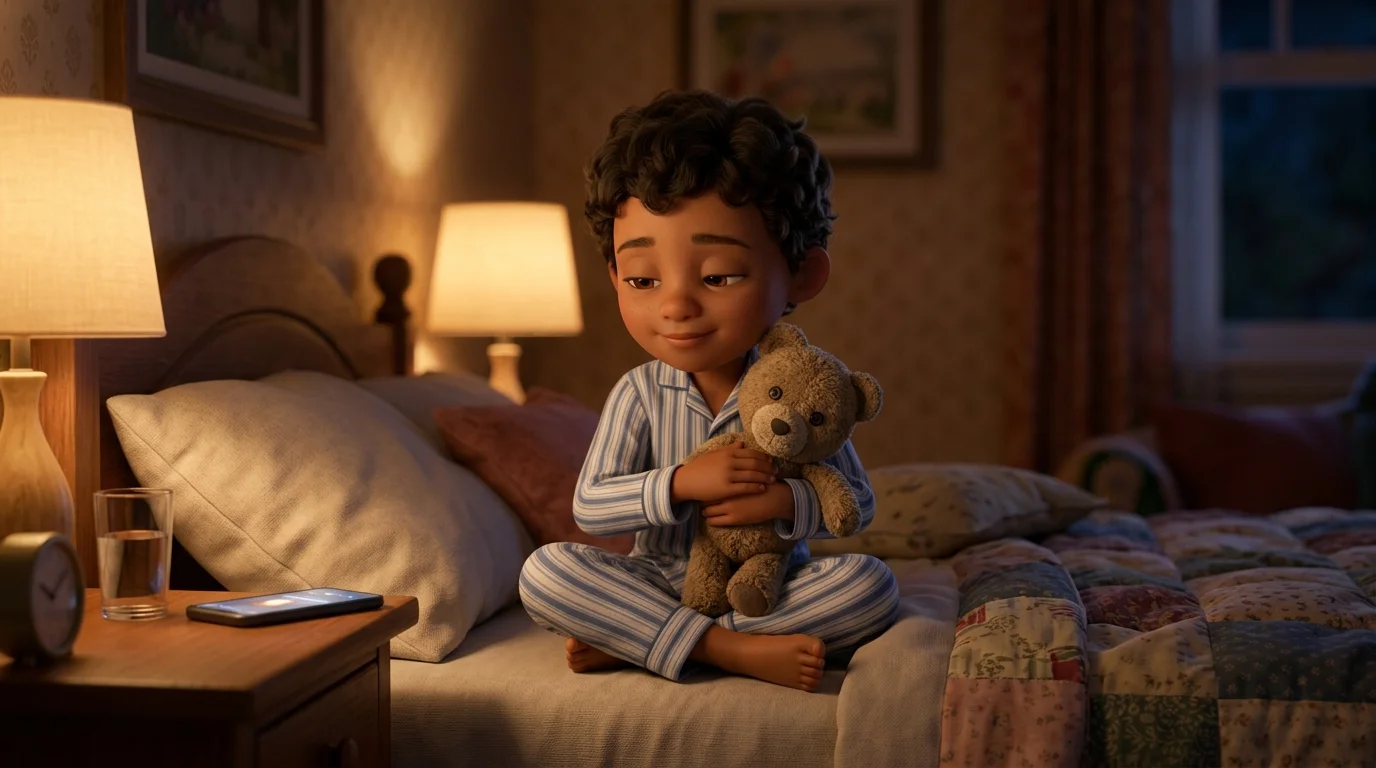
Three scenes narrated by a steady voice is exactly the Nanou format for this age. Dim the lights ten minutes before, cut the screens, lay the phone flat on the bedside table. The voice reading the story takes over, all you have to do is sit beside the bed, a hand on the back or a cuddly toy in reinforcement.
A trick that works well at four: telling the same story twice in the same week. Your child loves repetition and recognises with pleasure the scenes they already know. The more they know the story, the more it calms them, because they anticipate the reassuring ending. At this age, it is not a teaching mistake, it is a gift for sleep.
Remember the print-ready PDF option. Once the story is generated, you can download it as a PDF and print it at home or through any print service of your choice. Very useful at four, because your child often wants to turn the pages themselves during the day, even though they do not read yet.
A concrete three-scene pitch for a 4-year-old
Picture your child, first name Lou, four years old, in preschool. The cuddly is called Bunny, the dog is called Splash. Tonight's mission: Bunny has lost his plush carrot, it must be found before nightfall.
- Scene 1 · Lou and Bunny notice that the plush carrot has disappeared from the bedroom, Splash already sniffing under the bed.
- Scene 2 · Splash leads Bunny and Lou to the kitchen, where the carrot hides behind the apple basket, a sign it just wanted a cuddle from the basket.
- Scene 3 · Back in the bedroom, Bunny finds his carrot again, Splash earns a small biscuit, Lou closes their eyes and the house gently goes to sleep.
Reassuring ending, lights down, sleep arriving. You can adapt this skeleton to a missing goodnight kiss, a lost plush star, a sock that ran away from the cuddly, a hug hiding somewhere in the house. The structure stays the same, and your child will recognise it with pleasure evening after evening.
Frequently asked questions
Is a three-scene story really enough at four?
Yes, three scenes are four to five minutes of narration, which is the optimal length for a 4-year-old at bedtime. Beyond that, attention drops and the soothing effect reverses. You can try six scenes around five, but not before.
Should every evening have a different theme?
No, the opposite. At four, repetition of the same world and the same characters is deeply reassuring. You can run the same hero and cuddly pair for a week without your child getting bored, they will anticipate the familiar ending with pleasure.
Can the cuddly toy be included by its real name?
Yes, and it is strongly recommended at four. Enter the cuddly's name (Bunny, Teddy, Mimi) at creation time. The identification effect is huge and it is what turns a generic story into a personal one.
My 4-year-old asks for the same story every evening, is that normal?
Very normal and even beneficial. At four, your child uses repetition as a soothing tool. The more they know the reassuring ending, the faster they fall asleep. You can generate a printed PDF version so they can have it on their bedside table.
Launch your 4-year-old's first mission
You have the hero, you have the cuddly, you have the dog. The only missing piece is the story itself. Nanou Studio handles the text, the 3D rendering and the narrating voice in a few minutes, all you have to do is press play at bedtime. Create your first personalised story on Nanou Studio and give your 4-year-old the role they are starting to ask for, evening after evening, the named hero of their own tiny preschool adventure.