The night your 6-year-old asks for a story with them inside it
Six is the age where bedtime stories shift gear. Your child has just blown out the candles, started Year 1 or first grade, sounded out their first proper words, and brought home a head full of new names. Leo, Sophia, Adam, Mia, these classmates have become characters in dinner table tales, and now they want to climb into bed too. When your 6-year-old asks for a story, it is no longer "tell me something", it is "tell me one with me in it, with Leo and with Splash saving everyone". This guide walks you through the right format, the right genres and the right cast to compose, evening after evening, a personalised bedtime story that truly settles a 6-year-old, without overstimulating or shutting them down.
Why six is a turning point
Six is the year your child starts to read for real. They sound out syllables, recognise frequent words, follow a sentence on a printed page. Spoken language has already exploded at five, but at six it is fine comprehension that consolidates. They can track a structured six-scene story, identify the hero, the obstacle and the resolution, and most importantly they argue with the narration along the way. "No, Splash would have jumped from the other side." That interruption is not distraction, it is the opposite. Your child is stepping into the story.
On the emotional side, six is also the age where fear of the dark sometimes settles in, dreams diversify, and your child can wrestle with small worries linked to school or to a classmate who refused to play. The American Academy of Pediatrics resources on grade-school child development describe how this age concentrates important cognitive and emotional shifts, and how a steady evening ritual remains a key anchor for falling asleep.
Identification with the hero gets more demanding too. At six, your child wants a hero in their own image, not a generic figure. The first name matters, the classmate matters, the dog matters. A story that mentions "the little boy" or "the little girl" without a proper first name now feels flat.
Genres that truly land at six
Among the eight themes available on Nanou Studio, five stand out for a 6-year-old:
- Adventure remains the clear favourite. Your child loves being the one who sets off, explores, overcomes a small obstacle and comes safely home.
- Superhero lands very strongly. This is the age where capes, powers and the idea of protecting smaller kids are deeply attractive.
- Gentle mystery works better than at five. Your child has the focus to follow a multi-clue investigation.
- Fantasy opens the door to possible worlds, invented creatures, talking forests.
- Comedy is an excellent secondary pick because most 6-year-olds have a real sense of humour by now.
Science fiction works at six if the story stays accessible, for example a rocket trip with a friend and a robot learning to laugh. Horror, even the soft kind, is best handled carefully. Nanou's format never goes into hard horror, only mild thrills, but even so most children are happier waiting until seven or eight.
For length, the sweet spot at six is six scenes. That gives you nine to ten minutes of narrated story, enough to set up a world and offer a real resolution, short enough not to wake the sleep that is settling in. Stick to a single obstacle, solved by the hero with help from their circle. Avoid multiple twists, they sharpen attention instead of softening it.
Browse personalised adventure stories and superhero stories to see how this plays out for a 6-year-old.
The classroom cast, the ingredient that makes the difference
At six, your child has left reception and entered Year 1 or first grade. Their classroom is populated with first names that matter more than ever. The playground friend, the lunch table neighbour, the older Year 3 kid who plays football. These names belong in the story because they are part of your child's real world. Nanou Studio lets you add this secondary cast at creation time, name by name. Keep it to two or three names per story to avoid drowning out the main hero.
The family pet stays central at six. The house cat, the dog, sometimes a hamster or a goldfish, become characters in their own right. If your child has a dog named Splash, then Splash is the one who picks up the trail, Splash who finds the missing toy, Splash who saves the ending. The emotional investment is huge and it is a powerful attention lever.
Older siblings, younger siblings, the family baby slot in easily. Give each one a small part. An older sister who lends a torch, a baby brother sleeping nearby who needs protecting, a parent packing a snack for the mission, all of that anchors the story in your child's real world.
At six, a new dimension joins the cast: the Year 1 teacher. Your child mentions them twenty times a day. You can write them in as a friendly secondary character, perhaps the one who quietly hands the mission to the hero on the school steps. That school anchor gives your child the quiet pride of linking their real school to their bedtime story.
The right format for the evening ritual
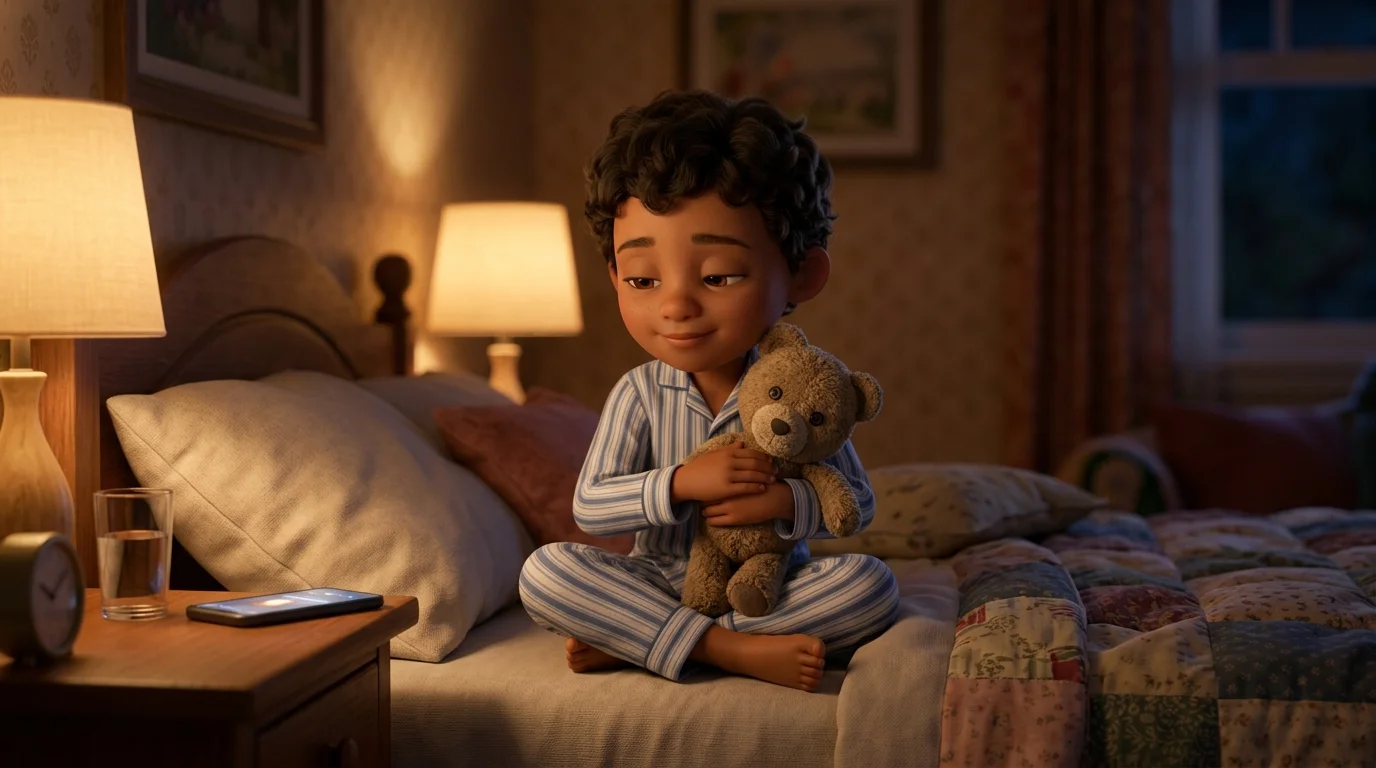
For a 6-year-old, aim for nine to ten minutes of story at bedtime, no more. Beyond that, attention drops and the soothing effect reverses. The pediatric guidance on how many hours of sleep your child needs recommends keeping the wind-down short, predictable and screen-free. Six scenes narrated by a steady voice is exactly the Nanou format for this age. Dim the lights ten minutes before, cut the screens, lay the phone flat on the bedside table. The narrating voice takes over, all you have to do is be there.
Weekend mornings also work very well. Your child wakes early, you want twenty more minutes in bed, you launch a personalised story while you slowly come round. Coffee arrives between scene two and scene three.
Remember the print-ready PDF option. Once your story is generated, you can download it as a PDF and print it at home or through any print service of your choice. Handy for gifting to a grandparent who will want to read it in turn, for shelving alongside the regular books, or for a paper-only night when you want to skip the narrating voice. It is also a lovely keepsake from a year when your child learns to read and recognises their own first name at the top of the page.
A concrete six-scene pitch for a 6-year-old
Picture your child, first name Lena, six years old, in Year 1. Her best friend is Leo, her dog is Splash, her teacher is Miss Aurora. Tonight's mission: the school bell has disappeared overnight, and nobody can ring break time tomorrow morning.
- Scene 1 · Miss Aurora quietly hands the mission to Lena and Leo at the school gate, Splash waiting just outside.
- Scene 2 · First clue, mysterious footprints behind the canteen. Splash sniffs and pulls on the lead.
- Scene 3 · The heroes find a small drawing pinned to a wall, signed with a name they recognise.
- Scene 4 · A noise in the playground, they hide behind the bench and watch what happens next.
- Scene 5 · The bell is found, wrapped in a scarf left behind by an older Year 3 kid who just wanted to practise ringing it.
- Scene 6 · Back to class, Miss Aurora praises the team, Splash earns a biscuit, the older kid promises to ask next time.
Reassuring ending, lights down, sleep arriving. You can adapt this skeleton to a missing plush toy, a neighbour who lost their keys, a small treasure hidden behind the classroom board. The structure stays the same, and your child will recognise it with pleasure evening after evening.
Frequently asked questions
Is a six-scene story too long for a 6-year-old who falls asleep quickly?
Six scenes are nine to ten minutes of narration. That is the right length for most 6-year-olds. If your child often drifts off before the end, you can switch to a shorter three-scene format, or simply let the voice continue softly. The story still lands if it has caught them earlier on.
Should every story mention school and the teacher?
No, this is one option among many. At six, school occupies a central place but the hero can also live an adventure in a forest, by the sea, in an imagined castle. Mix up the worlds to keep your child interested.
How many classmates can I include?
Two or three names per story is the sweet spot. Beyond that, the main hero gets drowned out and your child's attention scatters. Rotate the classmates from one story to the next so each one gets a moment.
Can I print the story to give it to a grandparent?
Yes, every generated story can be downloaded as a print-ready PDF. The printing happens on your side, at home or through your preferred print service. It is a personalised gift that works very well for a birthday or a grandparent's Christmas.
Launch your 6-year-old's first mission
You have the hero, you have the classmate, you have the dog, you might even have the teacher. The only missing piece is the story itself. Nanou Studio handles the text, the 3D rendering and the narrating voice in a few minutes, all you have to do is press play at bedtime. Create your first personalised story on Nanou Studio and give your 6-year-old the role they keep asking for, evening after evening, the named hero of their own adventure.