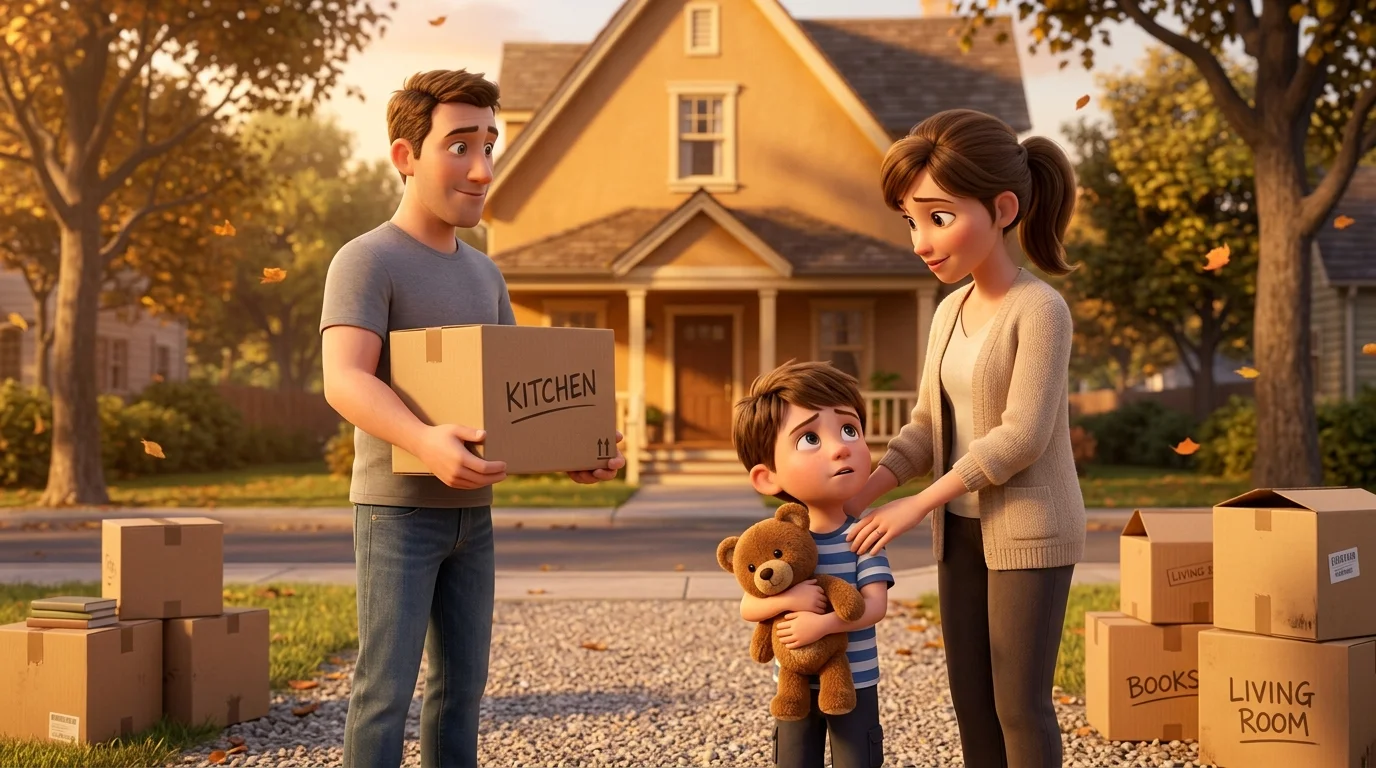
Moving and a new school: how to ease your child through the transition
You've known for a few weeks, or a few months, that you're moving. New city, new house, sometimes a new school mid-year or for the next fall. And the question that keeps looping is: how do I tell them? You're worried about the reaction, you're flashing back to your own childhood, you wonder if they'll experience it as a betrayal. This article gives you concrete reference points, without lecturing you and without miracle promises.
Announcing the move: timing and wording
Three questions to think through before you speak.
When do you tell them? As soon as possible once the decision is firm, but not before. Announcing while you're still on the fence creates anxiety for nothing. Once the offer is accepted, the lease signed, the relocation confirmed: you can talk. Ideally two to three months before the move date for kids four to eight · enough time to digest without letting dread set in too long.
Who announces it? Both parents together, in a calm setting, an evening or a weekend. Not in the car on the way to school, not during dinner with the grandparents around. This is a moment that deserves your full attention.
How do you frame it? Avoid "we have big news" (which sets up a positive expectation that's about to crash). Prefer a neutral, concrete sentence: "We have something important to tell you. We're going to move. We're going to live in a new house in X, it's this many miles from here. We're going to go through this together." Lay out the facts before asking for a reaction. Let the silence sit after the announcement, don't fill it with apologies.
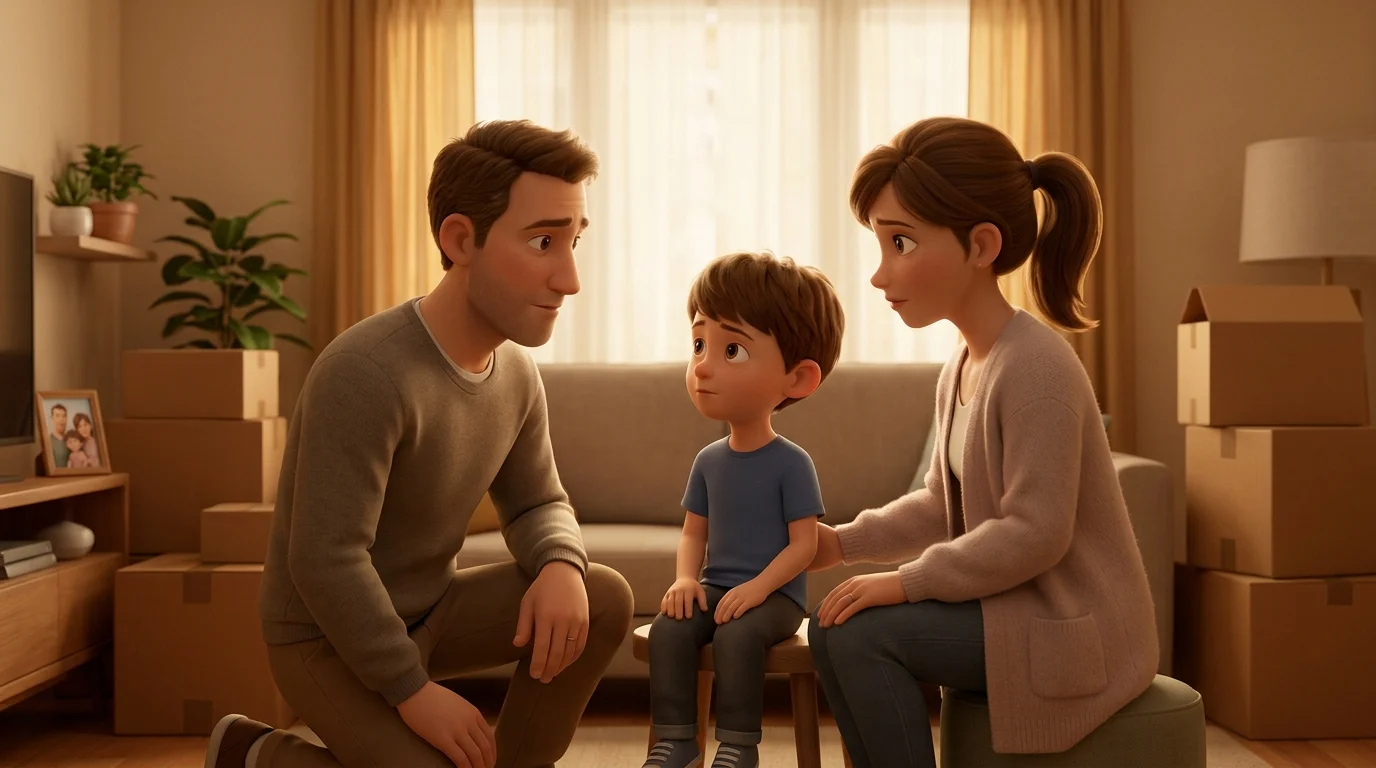
What your child will probably feel (and how to be there for it)
The most common reaction isn't sadness, it's anger. Your child senses that a major decision is being made for them, in a domain that matters (their home, their school, their friends). That's legitimate. Don't dramatize the anger, don't punish it. Validate: "I get that you're angry, I would be too. This is hard. And it's still going to happen."
The second reaction is fear of the unknown · new school, new friends, the worry of not making any. The worst thing to say at that moment: "You'll see, you'll love it!" Why? Because you don't know if they'll love it, you're imposing a feeling they don't have, and they shut down. Better: "It's going to be different. Some things will work for you, others won't. We'll talk about it, and we'll adjust."
The third reaction, often delayed, is the silent grief for friends and the current bedroom. Many kids don't cry the day of the announcement, but three weeks later, when reality lands. Watch for the small signals: unusual irritability, sleep trouble, asking for a long-abandoned stuffed animal. Each of these signs says "I need someone to talk to me about what's happening."
Tone to aim for: no pathologizing. This isn't depression, it's a transition. If regression lasts more than six to eight weeks after the move and disrupts sleep or potty training, talk to your pediatrician.
Involving your child in the prep (without overloading)
The right dose: they have a visible contribution they can proudly point to, not an adult responsibility.
Three things that really work:
- Visit the new house ahead of time if you can. Ideally a calm visit, no realtors, no rush. Your child needs to see, touch, walk through the rooms. If there's a yard, let them roam it. If there's a likely bedroom for them, let them explore it.
- Pick one or two things for their new room. Wall color, curtains, a poster. Not everything. You keep the structural decisions (bed, desk, storage), they keep the aesthetic ones (colors, accessories). It helps them project forward.
- Walk the new neighborhood ahead of time. Locate the new school, the closest park, a coffee shop, the grocery store. If you can, two or three short visits spaced out before the move. A four to eight-year-old's brain needs to map space to feel safe.
On the flip side, here's what doesn't work:
- Asking them to sort all their toys alone · exhausting and anxiety-inducing at this age.
- Bringing them to every house tour before the final decision · they experience the parade of choices as instability.
- Having them symbolically "sign" the offer · a gimmick that means nothing to them.
The new school: a transition within a transition
When the school changes too, this is often the hardest part of the move. Three levers to make it gentler:
- Visit the school before the first day. Ask the principal for a tour outside school hours. Your child sees the playground, the classroom that will be theirs, the bathrooms (yes, the bathrooms · it's concrete and reassuring), the gym. Most schools welcome this kind of advance visit.
- Prepare a short note for the new teacher. A few simple lines: "Our child is coming from this school, they have this temperament, they love this subject, here's their lovey's name in case." A teacher who gets this note adapts the welcome. Don't write three pages, stay factual.
- Keep in touch with one or two friends from the old school. Not everyone, that's unrealistic, but two. Parent-to-parent number swaps, the option of weekend visits, occasional video calls. It gives your child a thread of continuity, the idea that leaving doesn't mean losing.
The bedtime ritual, your best ally
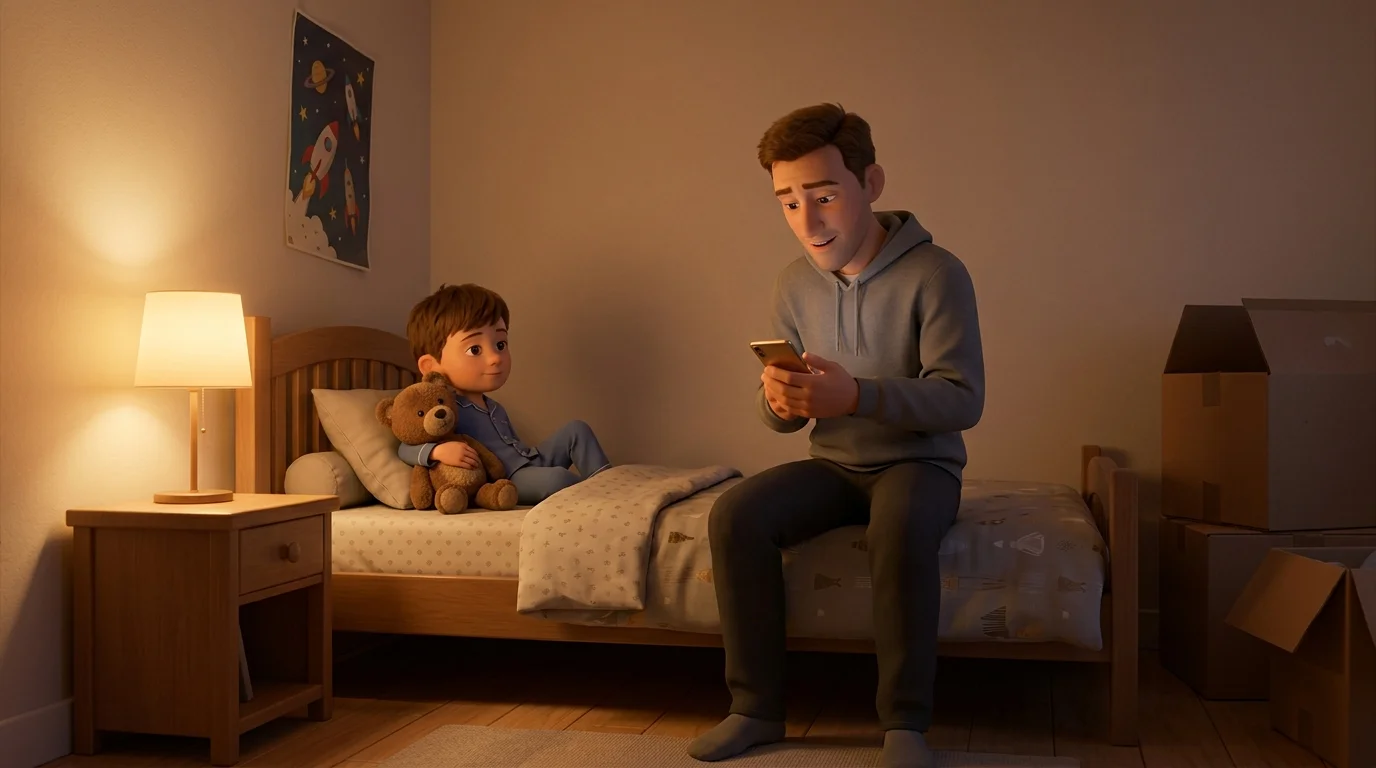
Throughout the transition period (announcement, prep, move, first weeks), keep the bedtime ritual intact. It's the stable element in an environment that's changing. Even if you're exhausted, even if boxes are everywhere, even if the bedroom isn't done: ten minutes of story at night, in bed, lamp on.
This is also where a personalized story can really help. Nanou Studio lets you create in five minutes a story where your child is the hero who moves house, discovers their new room, meets a new friend at school. Not a generic narrative pulled from the internet: their first name, their age, their dog Biscuit, their old friend Marcus, their new town · all of it goes into the plot.
Create a moving-house story for your child
And every story is automatically available as a printable book (a ready-to-download PDF), so you can keep a paper copy they'll find in their new room.
The first weeks in the new life
Be patient and be gentle. Three reference points for this stretch.
Accept temporary regression. Your child might ask for diapers again, want the parents' bed, refuse to go to school some mornings, cry for no reason. It's normal and it passes. Don't mock, don't punish, don't force. Stay with them and let time do its work · usually six to ten weeks until things stabilize.
Rebuild anchor points quickly. In the first days, take the time: walk to school together rather than driving, do the grocery run at the same store every Saturday, find a park that becomes "our park." A child's brain needs repetition to feel at home.
Don't expect instant friendships at the new school. Give it at least six to eight weeks before you worry. First friendships usually form around activities (a sport, an art class), not geographic proximity. If after two months nothing has started, organize a playdate at home with one or two kids from the class (on a discreet recommendation from the teacher).
Frequently asked questions
What age is a move hardest at?
Between 4 and 8 is generally the trickiest window. Before 3, the kid is still in primary attachment building, the move is harder on the parents than on them (provided the routines are preserved). After 9, the child already has an autonomous social life you have to account for, but they understand the stakes better. Between 4 and 8, they already have invested friendships and a school, without yet having the cognitive tools to put things in perspective. That's the window that demands the most preparation.
Should we keep the old school through the end of the year if possible?
If logistics allow, yes. For kids in pre-K, kindergarten, and early elementary, switching schools mid-year adds a significant layer of stress. For older kids (third grade and up), the break can be more manageable if you wait for summer to flip. If the move forces an immediate change, double down on the prep visit and the note to the new teacher.
My child told me they never want to move again. How do I respond?
Don't promise "this is the last one" if you can't be sure. Better to validate: "I get it, this is hard, and I'm going to do my best to make sure you feel good here." A broken promise later would do more damage than no promise now. If you're certain you're staying, you can say so ("We're going to live here for several years").
Does a personalized story really help with a move?
It doesn't solve the underlying problem (the transition takes real time), but it helps on two mechanisms. First: it names the situation within a reassuring story frame, which helps emotional processing. Second: it places your child as the active hero of a story where they move and they land, rather than a passive spectator of an adult decision. Many parents tell us the kid keeps asking for the story for weeks, like a narrative comfort object.
In short
A move with a kid is never just logistics. Announce clearly, validate the hard feelings, involve without overloading, visit the new school, protect the bedtime ritual, and accept the temporary regression of the first weeks. You can't make the transition painless, but you can make it digestible.
If you want to create a personalized story right now where your child is the hero who moves house, the first one is free on Nanou Studio, no credit card required.