What is actually happening in the waiting room
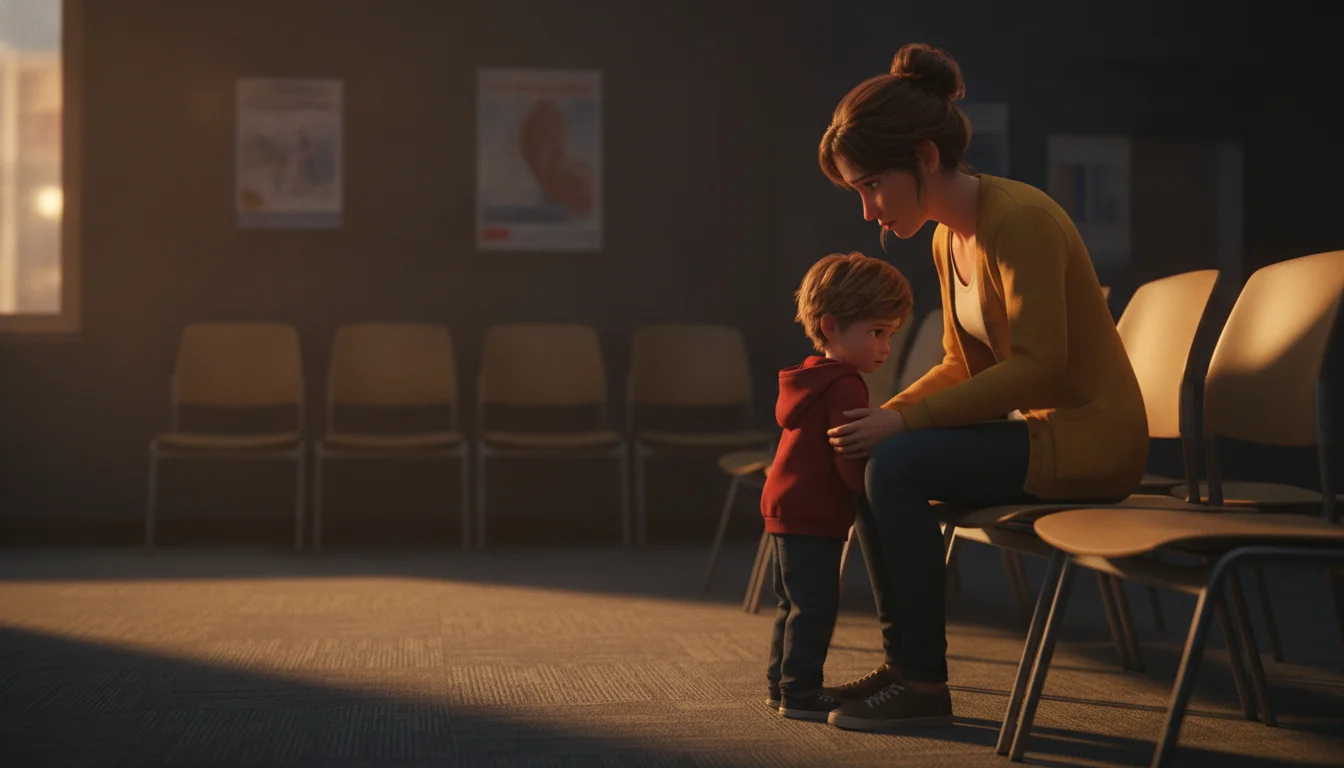
A three to six year old who digs their heels in outside the exam room is not being difficult. They are facing a situation that ticks, all at once, every box their brain files under risky: an unfamiliar place, an unusual smell, a grown-up they have never met who is about to touch them, and above all something they do not control and whose ending they cannot picture.
At that age, "it is for your own good" has no traction at all. Your child does not trade present discomfort for future benefit. They live in the moment, and in the moment they are being asked to sit still while a stranger looks inside their mouth. Paediatricians regularly point out that apprehension before a medical visit is a normal reaction in young children, not a character flaw to be corrected.
The good news is that this particular fear responds very well to three simple levers. And not one of them requires you to lie.
Lever one: tell them at the right moment
This is the least intuitive part, because the two mistakes are mirror images of each other.
- Telling them three days ahead hands your child seventy-two hours to stew. At four, the idea of a delay is blurry: "Thursday" means "soon, and I do not know when". Every evening becomes the night before.
- Saying nothing until the waiting room does the opposite and something far worse: your child works out that something was hidden from them. Next time, every car journey becomes suspicious.
The right setting sits between the two: the same morning. Over breakfast, crouched down to their eye level, one short honest sentence.
And above all, tell it in order. A young brain is reassured by a sequence, not by a promise:
- We are taking the car, and we will sit in a room with chairs.
- We will wait, maybe for a while, and you can look at your book.
- Someone will call our name.
- They will listen to your back with something cold, look in your ears and in your throat.
- Then we go home.
That list is worth more than every "do not worry" ever spoken. It turns a black hole into a marked path.
Lever two: play the scene before living it
This is the tip that surprises parents most, and it is by far the most effective.
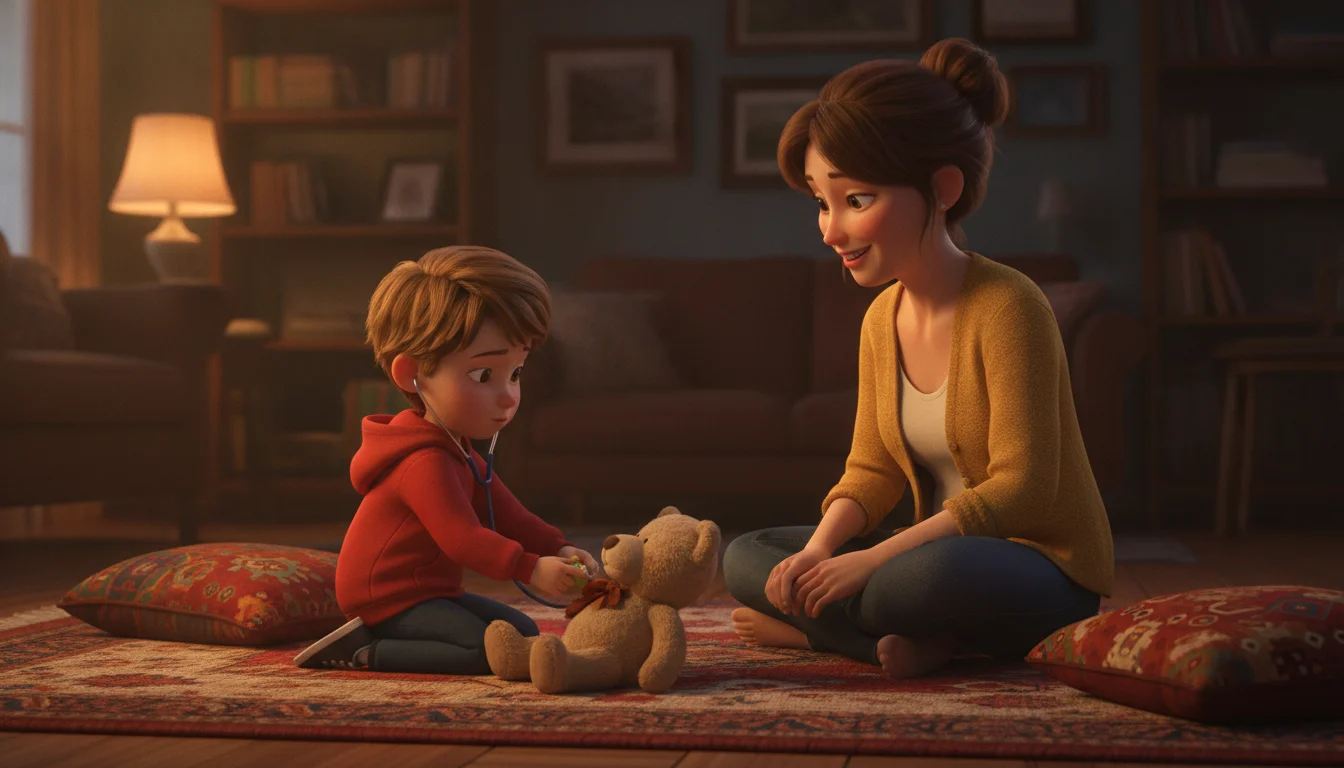
Get out a teddy or a soft toy and let your child play the medical role. They listen to the bear's chest with a spoon, look inside its ears, ask it to open wide. You can play the bear's parent, and ask out loud the questions your child does not dare ask.
Why it works so well:
- Play reverses the roles. In the real scene, your child is on the receiving end. In the game, they are the one holding the instrument. They move from the person something is done to, into the person doing it.
- What has been played out is recognised. When the real moment arrives, it is no longer a first time. The gesture has already been seen, smaller and less serious.
- Play surfaces the real questions. Plenty of children never ask "will it hurt". They ask, through the bear, "will they take my jumper off" or "does Mummy stay in the room". Those are often the questions that were blocking everything, and nobody had heard them.
Five minutes is enough. It is not a preparation session, it is a game, and it is better if it looks like one.
Lever three: never promise it will not hurt
This is the sentence that comes out on its own, and it is the one that costs the most.
If you promise there will be nothing, and there is a booster shot, you do not just lose that appointment. You lose your credibility for the next five. Your child will take away a simple and durable rule: when I am told everything is fine, that is when it hurts.
What you can say instead, and it fits in one line:
- "I do not know if there will be a shot. If the doctor gives you one, it stings hard for about as long as it takes to count to three, and then it is over."
- "I am staying right next to you, you can hold my hand."
- "You are allowed to say you do not like this."
That last sentence does a lot of quiet work. A child who is allowed to dislike something usually resists less than a child ordered to be brave.
The trap of the treat afterwards
The impulse is generous, and it works against you. Handing over a surprise on the way out signs a retrospective statement that the ordeal was terrible and deserved compensation. Your child does not conclude "that was easy". They conclude "that was so bad they paid me for it".
Instead, simply describe what you saw. Not a general compliment, a precise observation:
"You were scared, and you did it anyway. You kept your arm still even though you wanted to pull it away."
A child holds on to a sentence that describes their behaviour far better than to a "well done, you were so brave" that they do not know where to file. You are handing them an image of themselves to lean on at the next appointment.
Inside the room: give them a role
Once you are through the door, the best thing you can do is hand your child a little control over details that carry no stakes.
- Let them choose which arm.
- Let them hold the stethoscope, or place it on their own chest.
- Let them decide whether they climb onto the table themselves or want to be lifted.
- Let them keep their t-shirt on until the last moment.
None of these decisions changes the examination. All of them change how your child experiences it. Fear grows out of powerlessness far more than out of pain.
And if your child cries anyway: that is not a failed preparation. A child can be perfectly prepared and still cry. The goal was never to remove the fear, only to walk alongside it.
Closing the day on something else
A day with a medical appointment stays a heavy day. By the evening, your child needs it to end on an image that is not the waiting room.
That is exactly what the bedtime ritual is for, and it is where a personalised story earns its place. On Nanou Studio, your child becomes the hero of their own story, illustrated in cinematic 3D and read aloud, with their first name, their face, their friends and their pet. A family or adventure story where they are the one who goes through something and comes out the other side, on the evening of a day when they went through something.
It is no accident that children often ask, on that particular night, for a story where the hero is brave. They are putting their day away.
Frequently asked questions
At what age should I start telling my child about appointments?
As soon as your child talks and follows a simple instruction, so around two and a half or three, telling them beats saying nothing. Before that age the announcement does not mean much and how the moment itself unfolds matters more. After three, the same morning remains the right setting.
My child is already screaming in the car, what do I do on the way there?
Do not try to reason with them while they are screaming, they are no longer in a state to process an argument. Name what they feel without contradicting it, for example "you do not want to go, I know". Then come back to the concrete sequence: what will happen, in order, and what happens afterwards. Concrete details reassure when reasoning fails.
Should I stay in the room during the examination?
Yes, as far as possible, and especially if your child asks you to. Your presence is the anchor that makes the rest bearable. If a procedure requires you to step aside, warn them beforehand rather than disappearing at the last second, and tell them where you will be and when you are coming back.
How do I handle the fear of needles specifically?
Do not minimise it and do not dramatise it. Give it a duration, because pain with an announced ending is far more bearable than vague pain: it stings for as long as it takes to count to three. Offer to let them look away, squeeze your hand, or blow out hard at the moment of the jab. Blowing occupies the body and gives them something to do.
My child had a bad experience last time, how do I repair it?
Bring it up again when things are calm, a few days later, without making it a solemn subject. Let them tell their version, even an exaggerated one, and do not correct the details. Then replay the scene with a soft toy, giving them the medical role. Replaying a scene you had to endure is one of the most effective ways of digesting it, and children do it spontaneously when given the chance.