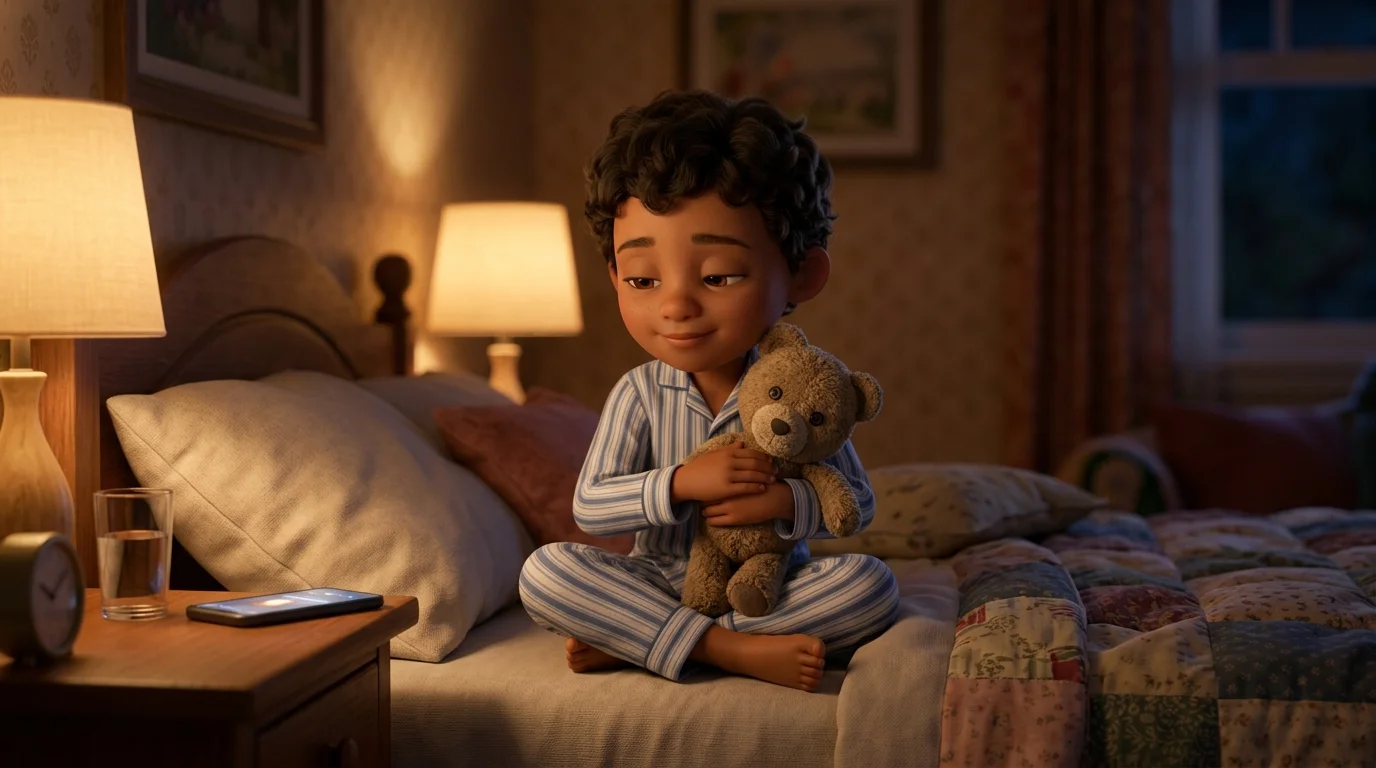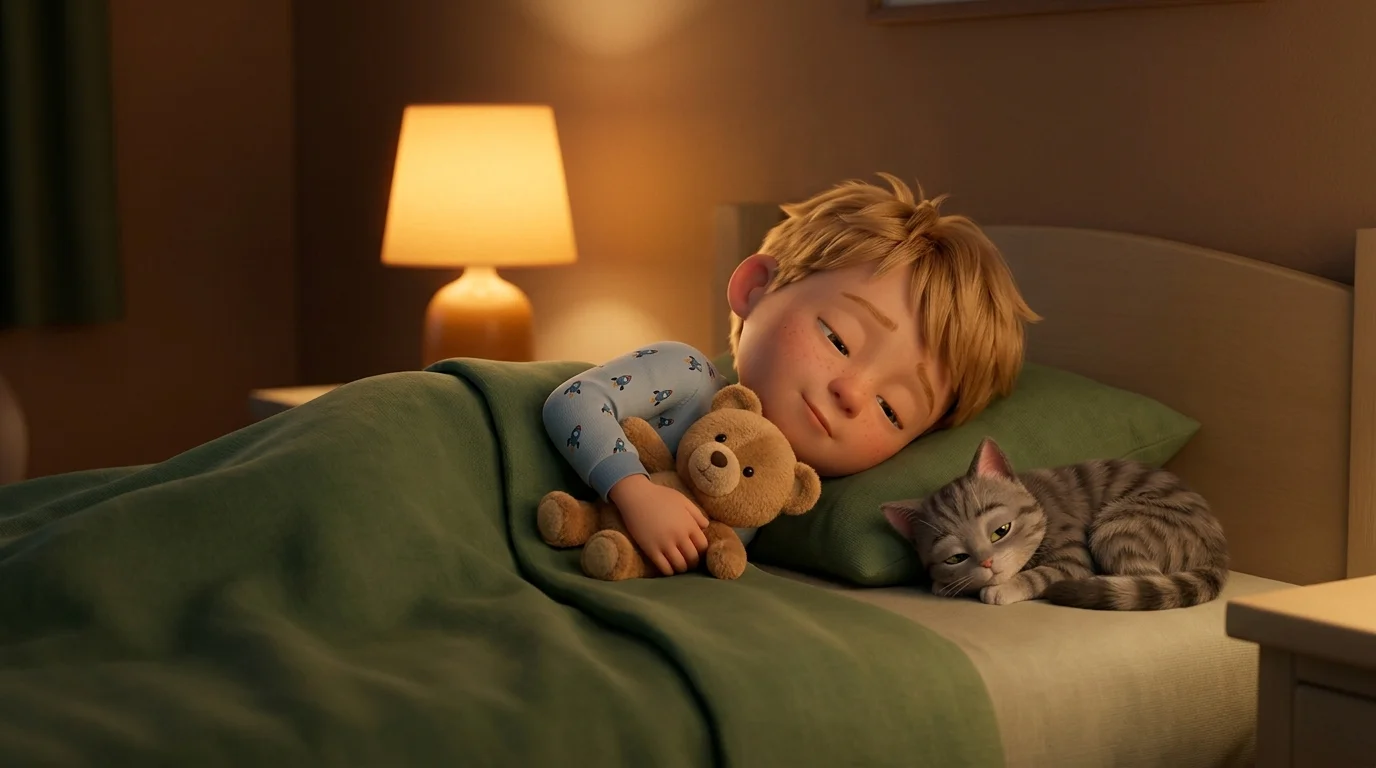
When your child wakes up crying in the middle of the night
Three in the morning, you hear footsteps in the hallway, then the small voice calling. Your child has woken up crying, they had a nightmare, they tell you about the wolf, the witch, the house that collapses, the endless corridor. You reassure them, open your arms, sit twenty minutes by the bed. The next evening, as soon as the lights go down, your child asks you not to leave. They are afraid of falling back into the same dream. This guide explains why nightmares are a normal developmental stage, what you can do concretely at bedtime to space them out, and how a well-tuned personalised story can, evening after evening, turn a recurring nightmare into a tame character.
Why a child has nightmares
Nightmares often appear around 3 years, peak between 5 and 8 years, then taper off in adolescence. They are not a tantrum, nor an automatic warning signal. They are the night work of an imagination that exploded during the day. Your child processes what they have seen, heard, felt, and sometimes the night stages a real fear (separation, school, moving house) or an invented one (the wolf under the bed, the monster in the closet).
The American Academy of Pediatrics resources on grade-school child development describe how nightmares are common at this age and do not reflect a psychological fragility in themselves. On the other hand, their frequent repetition over several weeks with daytime impact (tiredness, irritability, bedtime refusal) deserves a discussion with your pediatrician.
It is also useful to tell apart nightmares from night terrors. Nightmares happen in the second part of the night, your child truly wakes up, recognises you and recounts what they saw. Night terrors happen early in the night, your child screams or thrashes with their eyes open, but does not see you and remembers nothing in the morning. The two are not handled the same way. For night terrors, you do not intervene, you simply protect the environment. For nightmares, you reassure, you talk, you help your child take the controls back.
Five levers that actually reduce nightmares
To help your child cross a nightmare phase without straining the whole household, here are five levers to activate in order.
- Ritualise bedtime with three invariant steps: pyjamas, teeth, story. Predictability lowers end-of-day stress and limits emotional triggers.
- Cut screens one hour before bedtime, no exception. A slightly intense cartoon or a video glimpsed in passing can feed the next night's nightmare.
- Give the nightmare a name during the day. A named nightmare becomes a character, and a character can be mocked, drawn, parodied, and so tamed.
- Choose a personalised bedtime story that places your child in the hero role. Not a story that avoids the topic, not one that digs into it, but one where your child crosses a small fear and resolves it themselves.
- Keep a reassuring object within reach. A comfort toy, a soft night light, a worn parent t-shirt. These physical anchors help a lot for falling back asleep after a night waking.
The pediatric guidance on healthy sleep habits reminds parents that a short, predictable, screen-free wind-down is the first pediatric response to the most common sleep disturbances between 2 and 8 years.
Why a personalised story makes the difference on nightmares
A generic story stages a hero your child does not know. When you read them a tale where a small boy faces a witch, your child follows, but the projection stays external. A personalised story does the opposite: your child carries their own first name, their bedroom, their dog Splash, their cuddly Bunny. The hero is no longer someone else, it is them. And it is them, named in person, who tames the fear inside the story. That narrative shift is exactly what turns bedtime reading into a tool for emotional management.
With Nanou Studio, you compose the story in a few clicks with the everyday building blocks of your child's life. The hero carries their first name and their face in stylised 3D. The cuddly acts as a calm guide, the dog picks up the trail, the school friend lends a hand. The mission can stay simple and symbolic: finding the laugh of a lost character, returning a fallen star to the bedroom, walking a small sad ghost back home. No chase, no villain who wins, no sustained suspense. Just a small fear crossed, a clear resolution, a deeply reassuring ending.
Browse family stories and personalised adventures to compose the first anti-nightmare story tailored to your child.
The right format for a story that calms a nightmare-prone child
Among the eight themes available on Nanou Studio, four work particularly well during a nightmare phase.
- Gentle adventure, as long as the hero never strays too far from home and the ending brings them back to bed.
- Family, a very powerful spring to anchor emotional landmarks at a moment when the night feels threatening.
- Comedy, because making a child laugh just before sleep defuses much of the emotional tension.
- Light fantasy, within a recognisable world, with no scary creatures.
Explicitly avoid during a nightmare phase: horror even very softened, mystery with sustained suspense, open-ended science fiction. Superhero can work if the hero's power is gentle (soothing, repairing, reassuring) rather than combative. Six scenes from age 5, three scenes for ages 2 to 4. Beyond that, attention drops and the soothing effect reverses.
Favour calm narration, a steady voice, a single light from an amber night lamp. Cut the phone, lay it flat on the bedside table. The voice reading the story takes over, all you have to do is be there beside the bed.
A concrete six-scene pitch to tame a nightmare
Picture your child, first name Sam, 6 years old, who has been dreaming of a small ghost in the hallway for a few nights. Their cuddly is Bunny, their dog is Splash. Tonight's mission: help the little ghost find its way home, because it was just lost and afraid alone.
- Scene 1 · Sam hears a small sob in the hallway, Bunny perks up an ear, Splash lifts his head.
- Scene 2 · Sam switches on the amber night light, the little ghost appears at the corner of the wall, looking confused, it did not know how to get back.
- Scene 3 · Sam steps gently forward, asks its name, the little ghost is called Feather.
- Scene 4 · Splash picks up the trail, Bunny walks ahead, Sam and Feather follow by the light of the lamp.
- Scene 5 · Feather recognises a forgotten door, behind which the whole little ghost family is waiting.
- Scene 6 · Sam gently closes the door, Bunny whispers goodnight, Splash returns to the foot of the bed, the bedroom becomes calm again.
Reassuring ending, lights down, sleep arriving. You can adapt this skeleton to a hallway shadow that turns out to be a cat, a kitchen noise that is just the fridge, a silhouette behind the curtain that is a lost friend. The structure stays the same, the nightmare becomes a character we walk back home, and your child is the guide, not the target.
Remember the print-ready PDF option. Once the story is generated, you can download it as a PDF and print it. Keeping the story within reach, as a small booklet on the bedside table, prolongs the soothing effect for weeks.
Frequently asked questions
When should I worry about my child's nightmares?
Nightmares are common between 3 and 8 years and are not pathological as long as they stay temporary. If frequency exceeds two to three nightmares per week for more than a month with daytime impact, talk to your pediatrician.
Should I wake a child having a nightmare?
No. If you hear them whimper but they do not call out, stay nearby and watch. If they wake up by themselves, reassure them calmly, do not dig into the content of the nightmare, and help them fall back asleep.
My child wants to tell me their nightmare in the middle of the night, do I listen?
Briefly and calmly. Night is not the moment for long analysis. A short sentence ("I am here, it is over, you can go back to sleep, we will talk about it tomorrow morning if you want") is enough. The debrief can happen at breakfast, in daylight, in a reassuring setting.
Can a personalised story really space out nightmares?
For most children, yes. The density of familiar markers and the named hero position lower the background anxiety level, which reduces the raw material for nightmares. It does not replace professional support if nightmares become overwhelming.
Start the story that will help your child tame their nightmares
You have the hero, you have the cuddly, you have the dog, you have the bedroom. The only missing piece is the story that turns the fear around. Nanou Studio handles the text, the 3D rendering and the narrating voice in a few minutes, all you have to do is press play at bedtime. Create your first personalised story on Nanou Studio and give your child going through restless nights a tale that places them back, evening after evening, in their role as the named hero of their own adventure.