When your 7-year-old starts to co-author their own stories
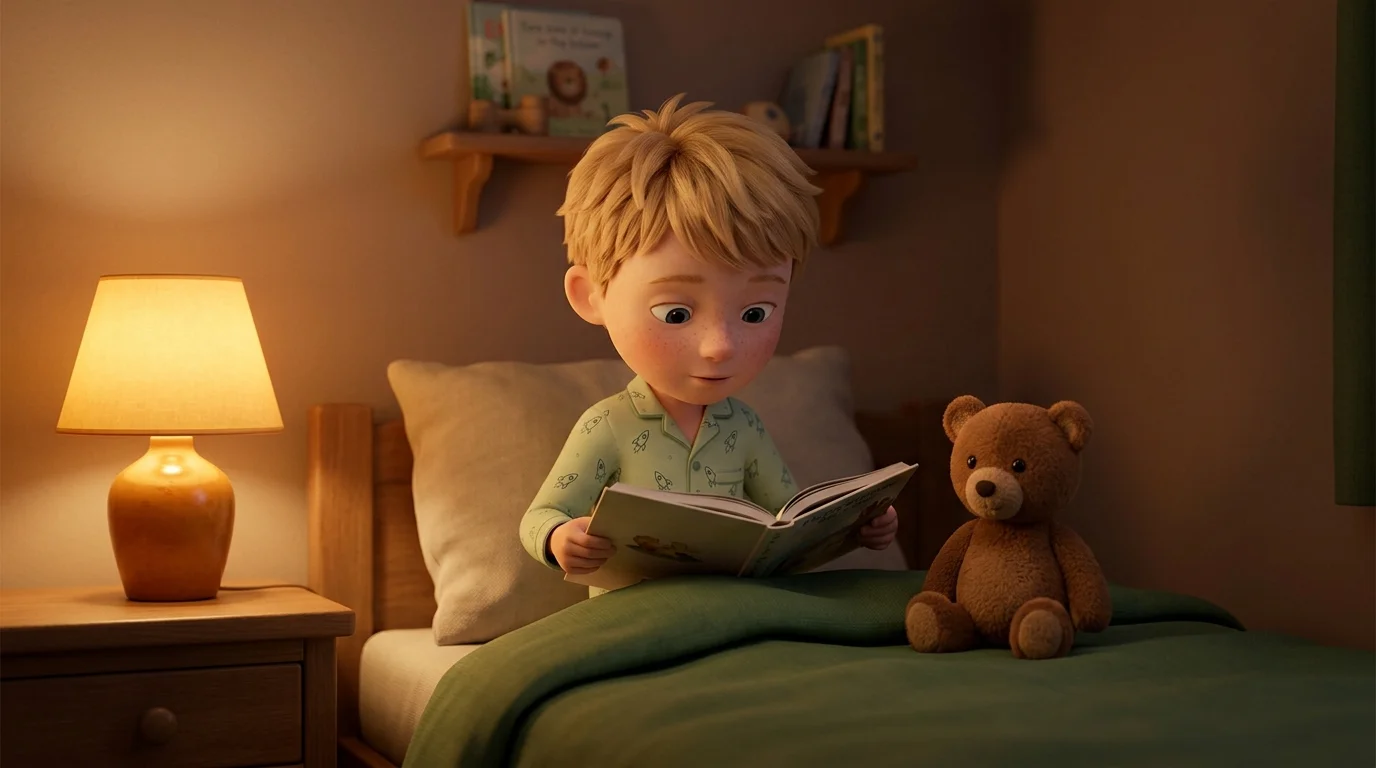
Seven is the age where your child stops just listening to the bedtime story and starts cocreating it. They have finished Year 1, they are entering Year 2 or second grade, they are reading their first solo pages, they come downstairs to discuss the book they started in their bedroom. At bedtime, they no longer simply listen. They suggest the hero, the genre, the setting, the classmate they absolutely want to feature. At this precise age, the personalised story takes on a new dimension. It becomes a piece your child copilots, in which they appear named in person. This guide gives you the right settings to compose, evening after evening, a story that truly soothes a 7-year-old, respects their narrative intelligence and slides gently toward sleep.
What changes at seven
Seven is the great year of independent reading. Your child decodes fluently, recognises hundreds of frequent words, starts reading silently. Spoken language stabilised at 5-6, at seven it is fine narrative comprehension that takes another leap. They instantly identify the hero, the obstacle, the resolution. They anticipate the ending before it arrives. They argue with the character's choices along the way. The American Academy of Pediatrics resources on grade-school child development describe how this age concentrates an explosion of narrative reasoning capabilities and how the evening ritual remains a major anchor for falling asleep, even when your child starts saying they are too old for bedtime stories.
On the emotional side, seven is also the age where your child more readily tests soft thrills, multi-layered humour and stories featuring classmates. They begin to enjoy mystery that runs across several scenes, heroes who doubt, endings that pivot on a clever detail. Science fiction that stayed too abstract at 5 suddenly becomes accessible if it speaks of friendship rather than technology.
Identification with the hero becomes demanding. At 7, your child wants a hero who truly looks like them, not a generic figure. The first name matters, the Year 2 teacher matters, the lunch friend matters, the Wednesday sport club matters. A story that ignores these markers feels hollow.
Genres that truly land at seven
Among the eight themes available on Nanou Studio, six stand out for a 7-year-old:
- Adventure remains the clear favourite. Your child loves embodying a hero who explores, who overcomes a more complex obstacle than at 5, who makes a tactical decision.
- Mystery takes full power at 7. Your child has the concentration to follow an investigation with three or four clues spread across six scenes.
- Superhero keeps working, but the power must serve to protect rather than dominate. 7-year-olds love useful heroes.
- Fantasy opens the door to parallel worlds, talking forests, animals with their own language.
- Comedy takes a new dimension, because your child understands layered humour and enjoys simple wordplay.
- Science fiction, as long as it speaks of friendship, travel and discovery rather than abstract technology.
Horror even very softened is still best handled with care at 7. Nanou's format offers gentle thrills, never hard horror, but it is better to wait until 8 for most children and keep the evening slot for more soothing genres.
For length, the sweet spot at 7 is six scenes. That gives ten to twelve minutes of narrated story, enough to set up a world, build a soft suspense and offer a real resolution. Stick to a main obstacle plus a small secondary twist, solved by the hero with help from their circle. A gentle cliffhanger between scenes keeps attention without triggering anxiety.
Browse personalised adventure stories and mystery stories to dial in the first missions for Year 2.
The cast that speaks to a 7-year-old
At 7, your child has entered Year 2 or second grade. Their classroom is populated with first names that matter more than ever. The playground friend, the lunch friend, the table neighbour, the Year 3 kid who plays football with them. These names belong in the story. Nanou Studio lets you add this secondary cast at creation time, name by name. Keep it to two or three names per story to avoid drowning out the main hero.
The family pet keeps its central place at 7. The cat, the dog, the hamster, the goldfish, become characters in their own right with recognisable temperaments. If your child has a dog named Splash, then Splash is the one who picks up the trail, finds the hidden treasure, saves the ending. The emotional investment is huge.
Older siblings, younger siblings slot in easily as secondary characters. The Year 2 teacher can be cited as a friendly figure handing the hero a mission at the school steps. The Wednesday sport club coach, the next-door neighbour, the local baker, all this ecosystem of proximity gives the story the density your 7-year-old asks for.
At 7, an extracurricular activity also joins the cast. Your child plays football on Wednesdays, dances on Saturdays, does judo on Tuesdays. You can integrate this activity as an adventure setting, for example a club trophy that disappears and the hero must find before the tournament.
The right format for the evening ritual at 7
For a 7-year-old, aim for ten to twelve minutes of story at bedtime. Beyond that, attention drops and the soothing effect reverses. The pediatric guidance on healthy sleep habits reminds parents to keep the wind-down short and steady, even when your child starts negotiating that wind-down.
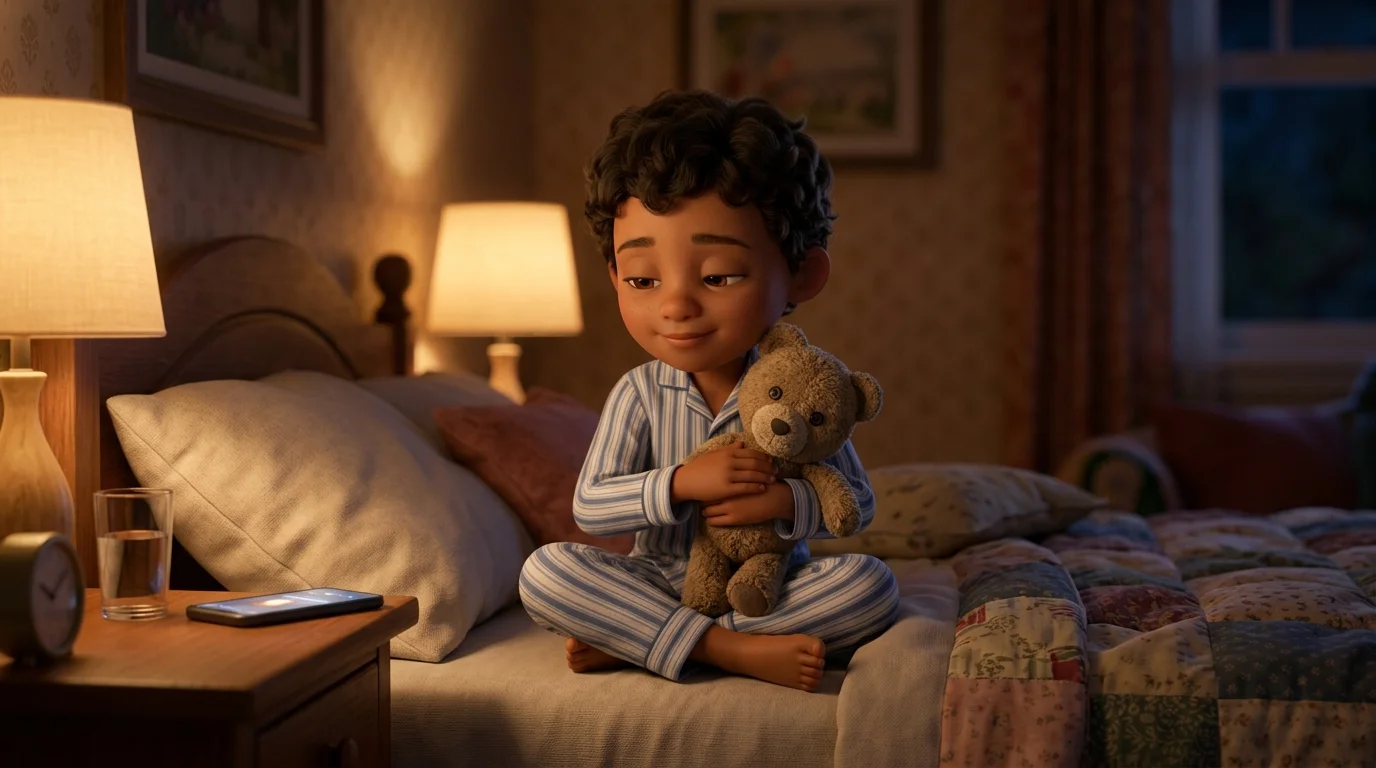
Six scenes narrated by a steady voice is exactly the Nanou format for this age. Dim the lights ten minutes before, cut the screens, lay the phone flat on the bedside table. The narrating voice takes over, all you have to do is be there beside the bed.
At 7, your child can also start listening to the story alone, with a parent in the next room. That autonomy often marks the moment the ritual stabilises for several years. The point is the regularity of the moment, not the permanent physical presence.
Remember the print-ready PDF option. Once your story is generated, you can download it as a PDF and print it at home. At 7, your child starts reading alone, so the printed story becomes an object they consult during the day. A lovely keepsake from a year when they cross the independent-reading milestone and recognise their own first name at the top of the page.
A concrete six-scene pitch for a 7-year-old
Picture your child, first name Sasha, 7 years old, in Year 2. Their best friend is Leo, their dog is Splash, their teacher is Miss Aurora, and they play football on Wednesdays. Tonight's mission: the official club ball has disappeared just before Saturday's tournament, and the coach is counting on Sasha to find it.
- Scene 1 · The coach quietly hands the mission to Sasha and Leo at the end of Wednesday training, Splash waiting outside the club.
- Scene 2 · First clue, footprints in the grass behind the changing rooms, Splash sniffing and pulling on the lead.
- Scene 3 · The heroes find a small clue against a post, a scribbled name they recognise.
- Scene 4 · A noise in the equipment room, they hide behind the cage and watch what happens.
- Scene 5 · The ball is found, left behind by an older Year 4 kid who just wanted to practise penalty kicks.
- Scene 6 · Back at the club, the coach praises the team, Splash earns a biscuit, the older kid promises to ask next time and offers to invite Sasha to the next special training session.
Reassuring ending with a friendship opening, lights down, sleep arriving. You can adapt this skeleton to a dance trophy, a judo medal, an athletics club stopwatch, a class library book. The structure stays the same, and your child will recognise it with pleasure evening after evening.
Frequently asked questions
My 7-year-old says they are too old for bedtime stories, should I insist?
Insist on the ritual, yes. Insist on the format, no. At 7, some children want to listen autonomously while you are in the next room, or read along themselves. The narrated voice still helps those who can be soothed by it. Adapt the posture, keep the evening rendezvous.
How many classmates can I include at 7?
Two or three names per story is the sweet spot. Beyond that, the main hero gets drowned out and your child's attention scatters. You can rotate classmates from one story to the next so each one gets a moment, which creates a small recognisable saga.
Can the sport club or Wednesday activity be integrated into the story?
Yes, and it is strongly recommended at 7. The football club, the music school, the dance class, all this extracurricular ecosystem gives the story the density your child is asking for. Indicate the activity at creation time.
Can I print the story so my child can read it alone?
Yes, every generated story can be downloaded as a print-ready PDF. At 7, your child starts reading alone, so the printed story becomes an object they consult during the day. It is also an ideal personalised gift for a grandparent or a friend's birthday.
Launch your 7-year-old's first mission
You have the hero, you have the classmate, you have the dog, you might even have the sport club. The only missing piece is the story itself. Nanou Studio handles the text, the 3D rendering and the narrating voice in a few minutes, all you have to do is press play at bedtime. Create your first personalised story on Nanou Studio and give your 7-year-old the role they keep asking for, evening after evening, the named hero of their own Year 2 adventure.