When the hallway suddenly looks like a vast ocean
It is 8:42 p.m. You have just turned off the main light, you have left the door open by exactly twelve centimeters, and already your child calls out: "Mum, dad, something is moving in the closet." You know the scene by heart. You also know that no rational explanation will defuse it. This article offers you a concrete parenting tool: the personalized bedtime story, where your child is the hero and where fear becomes a gentle adventure. Not a therapy, not a magic promise. Simply a ritual that helps.
Why fear of the dark is a normal stage of development
Between ages 2 and 7, a child's imagination explodes. This is precisely the window in which they learn to tell the real from the imagined, and that boundary stays porous for a long time. The dark is not scary in itself: it is the absence of visual information that gives imagination free rein. Pediatricians regularly remind us that childhood fears and worries are a normal part of growing up: this is not a problem to correct, but a signal that your child's brain is integrating a new layer of how the world works.
That said, going through this phase can exhaust the whole family. Night wakings, refusing to go to bed, recurring nightmares are very common in young children: parents look for tools. The classic bedtime book is one, and a very old one. The personalized story, where the child is named and recognizable, goes one step further because it speaks directly to their narrative inner world.
Three narrative mechanisms that calm fear
Not all stories are equal when it comes to fear of the dark. Here are the three levers that work best, and that guide story creation on Nanou.
- Taming the monster. The closet monster is not chased away, it is named, sketched, gently made silly. In the personalized story, it becomes a side character who loves dirty socks, who is afraid of kisses, who falls asleep snoring like a trumpet. The child meets the creature again, but this time it is under narrative control. The next morning, the closet feels less threatening.
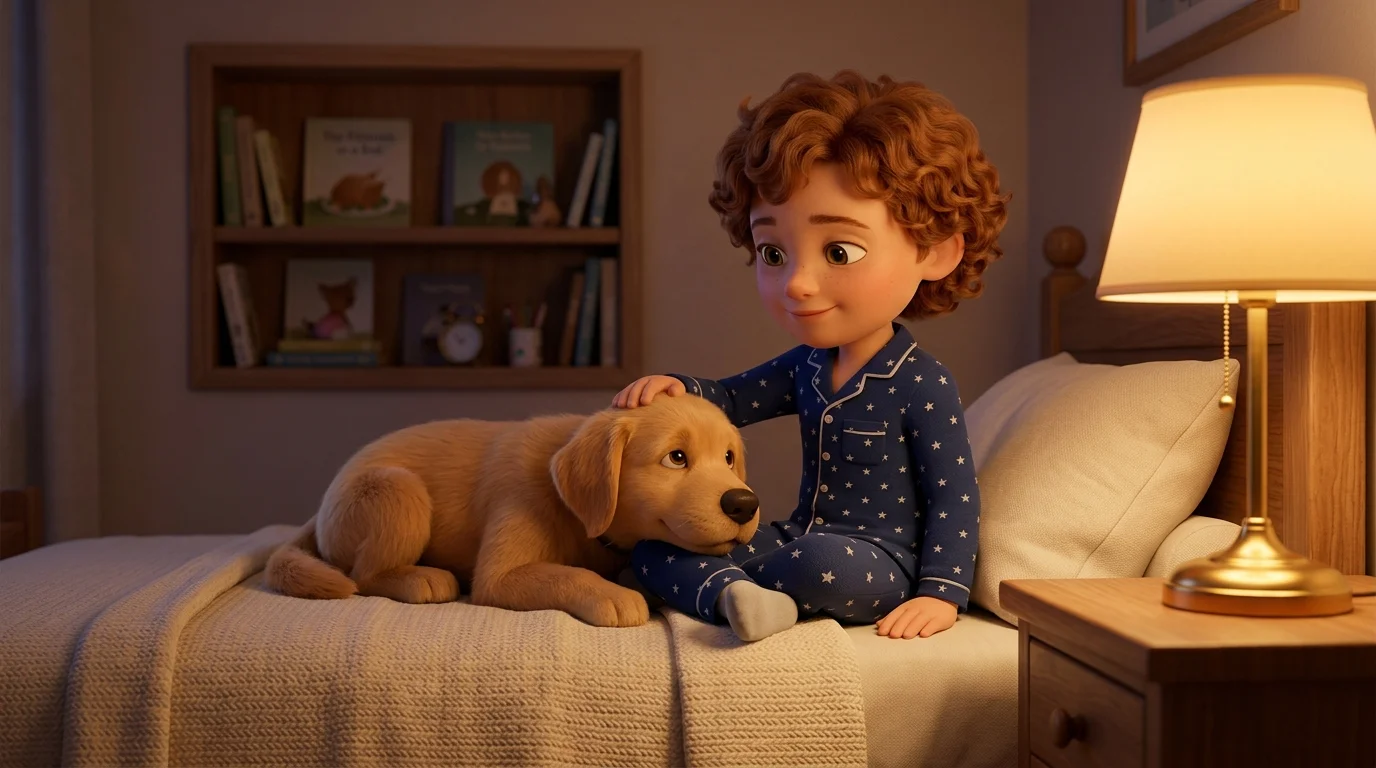
- The hero's power. Your child is not passive in the story: they discover a magic lamp, eyes that see in the dark, growing courage, a pet animal who keeps watch during sleep. That power stays with them, metaphorically, once the story ends. Psychologists call this a "narrative transitional object".
- The continuity of the voice. A Nanou personalized story is narrated by a soft, natural voice. That voice can be replayed if your child wakes up at 3 a.m. No need for an exhausted parent to read again in a whisper: just restart the playback on the tablet or phone, volume low. The familiar audio ritual becomes a safe anchor, a thread stretched from bedtime to morning.
Setting up the ritual: what actually works
The shape of the ritual matters almost as much as the content. Here are a few concrete benchmarks, tested by thousands of user families.
- Length: 5 to 9 minutes maximum. Beyond that, your child does not settle, they get excited. A Nanou story of 3 or 6 scenes fits exactly in that window.
- Low volume. The voice should feel like a presence, not a show. Place the device 1 or 2 meters from the bed, never directly on the pillow.
- Dim light, not full darkness. A warm night light, or the hallway light, is enough. Complete darkness right after a story is too harsh a transition.
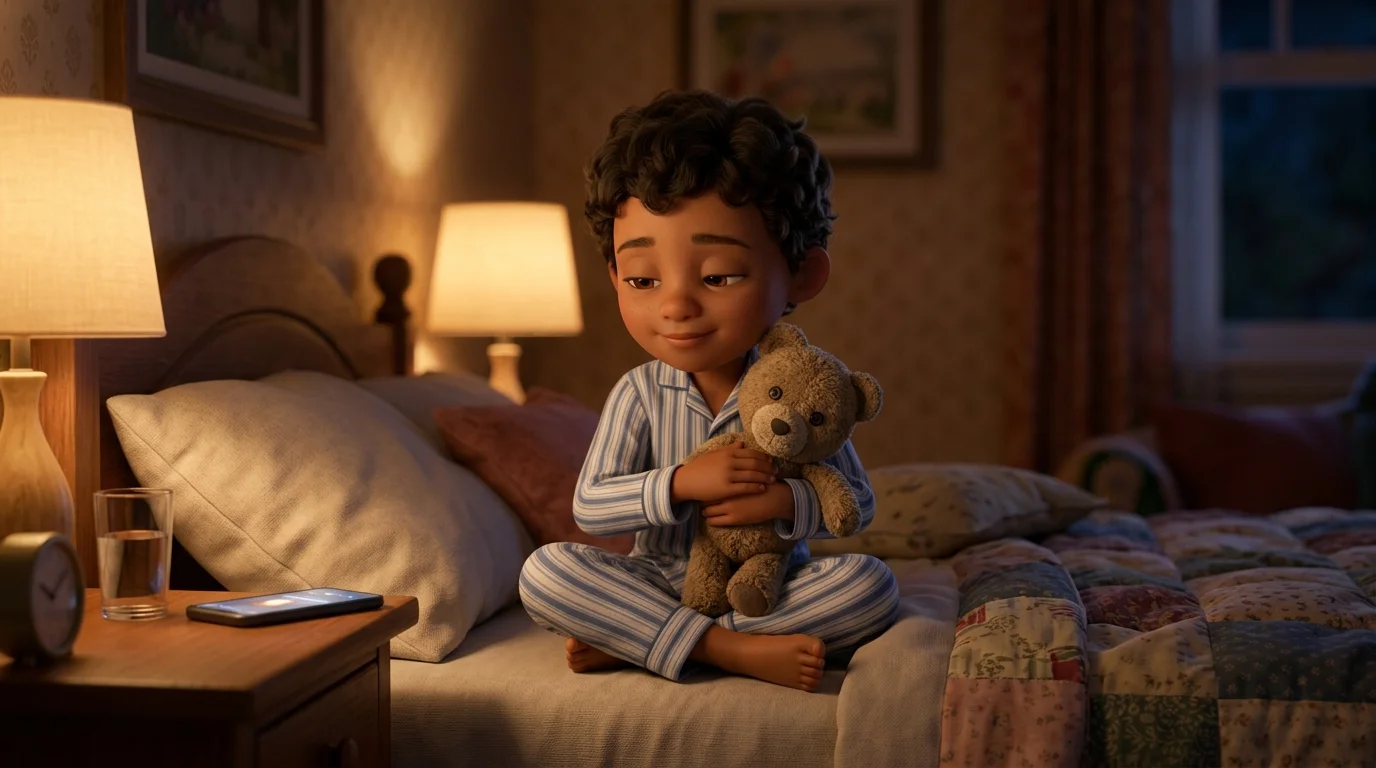
- Soft toy in hand. While the voice tells the story, the child's fingers should be busy. The favorite plush, a corner of the duvet, the worn-out bunny.
- Same time, same order. Brushing teeth, toilet, soft toy, story, kiss, light off. The brain loves predictable repetition: it reads as "everything is safe".
A gentle word of caution. If fear of the dark lasts more than a few weeks, gets worse, or prevents your child from reaching deep sleep, talk to your pediatrician: a persistent anxiety disorder in children deserves professional support. The personalized story is a complementary parenting tool, not a therapy. It supports, it is not meant to treat an entrenched anxiety.
A concrete pitch: the night Mia became friends with the shadow
Picture this. Mia, age 5, is afraid of the dark. You create on Nanou a story where she is the heroine, with her older brother Tom, their dog Pirate, and her preschool friend Hugo. The chosen theme: family, with a hint of mystery. Three scenes, six minutes of narration, illustrations rendered in 3D cinematic style in which Mia recognizes herself with her brown bob and her star pajamas.
Scene 1, Mia hears a noise in the closet. Tom joins her, Pirate barks once for the form. Scene 2, they open the closet door together: a tiny, soft creature, whom they name Twiglet, has lived there forever. He is shyer than they are. Scene 3, Hugo shows up the next day with a drawing of Twiglet, and the shadow in the closet has officially become a friend of the family.
The following night, Mia asks to listen again. Two days later, she whispers to her plush: "Twiglet is watching over us." Fear did not vanish in a single wand wave, but it has a name, a shape, and a place in a story that ends well. That is exactly what a bedtime ritual is supposed to do.
FAQ
From what age does a personalized story help with fear of the dark?
From around 2 to 3 years old, your child recognizes their first name and their face in an illustration. That is the tipping point at which personalization really makes sense. Before that, a classic tale does the job. After 7, the child enters another phase, and the effect remains positive on other levels.
Should the monster always appear in the story, or is it better to avoid it?
It depends on your child. Some need to see the monster tamed in order to move forward, others prefer a story in which fear is never named. On Nanou, you choose the theme among 8: family, mystery, adventure, and more. Start gentle, adjust based on how your child reacts.
Can my child replay the story alone in the middle of the night?
Yes, that is one of the main perks of the tool. The Nanou personalized story is saved in the app, accessible at any time. You can also export the PDF to reread the printed version by flashlight. Nanou does not deliver printed paper: it is an export that you print yourself if you wish.
How often can the same story be reused per week?
As often as your child asks. Repetition is reassuring at this age. Many families keep the same story for two or three weeks, then create a new one when the child starts knowing the dialogue by heart. That is an excellent signal that they are ready for the next step.
Create the story that soothes your child tonight
Fear of the dark cannot be reasoned away, it is tamed. A personalized bedtime story, where your child is the hero, where the secondary cast reflects their real life, where the narrated voice becomes a familiar audio thread, is a simple and effective parenting tool. No magic, no promise. Just a ritual that turns bedtime into a soft moment.
To go further, explore our stories in the family and mystery themes, which are particularly suited to the mechanisms described here.
Create your child's story on Nanou Studio. In a few minutes, you hold a personalized story ready for tonight's bedtime.